Showing posts with label Donmar Warehouse. Show all posts

Saturday, 22 February 2020

So close… Far Away, Donmar Warehouse

Caryl Churchill’s plays are so diverse it’s difficult to pin down her style other than a brutal honesty mixed with strong characterisation and healthy humour. This play was first produced in 2000 and its vision of a Britain involved in a war on home turf and with martial law and public execution part of the entertainment of a ruthless single state, is far more frightening twenty years on. Maybe we just don’t see things as clearly as this playwright or we just delude ourselves harder but the hostile environment on display is all too believable.

The play is short – 40 minutes - as well as, ahem, being nasty and brutish and, personally, it has the aftertaste of a novella when there was perhaps more to say. It’s based on three sequences and whilst the first has the biggest shock value and the second has the most spectacular set-piece, the final section plays a little flat in comparison especially when the humour and horror that is balanced so well before this point breaks down to some plain daft ploys about animals and the weather being involved in the war. I get the point but not the continuous joke.

Jessica Hynes (Photo, Johan Persson)
The performances are very strong throughout and not least from young Sophia Ally as young Joan who features in the first section as she examines a large metal block that occupies the central stage. The block is raised revealing her Auntie Harper (Jessica Hynes) hard at work sewing; this is a time of make do and mend and more besides as the inquisitive Joan has already discovered on her first day staying out in the country. Joan has seen far more than she should and her question and answer with Harper is so well constructed, as every time the grown up thinks they have come up with a convincing way of explaining strange events away, they are demolished by something even darker the youngster has seen. Why was Uncle hiding those people, why was he hitting them and why were they crying? The brutality of the near-future Britain is revealed through the forensic cross-examination of a child.
Aisling Loftus and Simon Manyonda (Photo Johan Persson)
In the next section an older Joan (Aisling Loftus) is just starting her career as a milliner, making a glorious green feathered hat alongside Todd (Simon Manyonda) a more experimental and experienced man who explains the uncomfortable truth about the place they work. Their conversation hints at routine issues with workplace communication and employee relations and, again, we only gradually find out what they are doing and why.

The stage keeps on darkening to delineate the passing of days and every time the hats get bigger and more elaborate a visual gag that is only setting us for the darkest and most spectacular reveal of the play.

From there it’s only the final act as Joan returns to her Aunt’s home with Todd and more of the future Britain’s realities are set out in sharp relief to that off-kilter humour.

IThankYouTheatre rating: *** Director Lyndsey Turner has created some startling moments and the staging makes the most of the Donmar’s intimacy but for me the intensity wavers in the final third.

Far Away plays at the Donmar until 28th March – booking details on their website.


Friday, 2 November 2018

Thee too… Measure for Measure, Donmar Warehouse


“…Dear Isabella,
I have a motion much imports your good;
Whereto if you'll a willing ear incline,
What's mine is yours and what is yours is mine.
So, bring us to our palace; where we'll show
What's yet behind, that's meet you all should know.”

To which Hayley Atwell’s Isabel turns to Duke Vincentio, and screams!

This was no ordinary Shakespeare and in taking such liberties with the text, was almost certainly not to the taste of many. Having no familiarity with the play, I was surprised – once again – about how the subject matter was so very now… almost as if, in the hands of a talented cast, the words find their true mark even in our contemporary minds, removed from their meaning by time and texting.

Measure for Measure is about justice and the casual ways in which access to the law can be traded for sexual favours: it’s a comedy but not really, this was a late-period play under a new monarch that opened the lid on the ways of the world be it legal, be it theatrical. Even Will may have had to turn a trick or two…

But, does this timeless tale of sexual give and take need much updating? The first half played things out in traditional period style with Hayley as Isabella fighting to save the life of her brother Claudio (Sule Rimi) who has been harshly sentenced to death for infidelity by Justice Frederick (Ben Allen) who has been placed in charge of legal judgement by Duke Vincentio (Nicholas Burns), who, for reasons of his owns, has opted to drop out of sight as a poor priest.

Nicholas Burns and Hayley Atwell
The Duke wants to see how things work without his wisdom and, sure enough soon finds Frederick being compromised by power as he suggests to the chaste Isabelle that the only way to save her brother is to sacrifice her honour to his lust. Now, hearing of this, the Duke/Priest hatches a plan to substitute the Justice’s former betrothed, Mariana (Helena Wilson), who willingly gives herself to the evil Fred in Isabella’s place, and the lecherous lawyer doesn’t even notice…

Now all of this will come to a head once the Duke reveals himself and there are neat Shakespearean ends all tied up as measure is swapped for measure but… are they? The ending of the play is left open and we never know if Isabella accepts the “reward” of the Duke’s love or, as here, throws it back in his face.

Now, this is where it gets troublesome as not only does Josie Rourke’s energetic production shift events forward to now, she re-runs the narrative only this time with a power-dressed Atwell as Justice Isabelle and Frederick as a meeker-than-Isabelle brother of Claudio. It works in part as Atwell is simply outstanding in both halves but, overall, it’s game over in that high-pressing opening hour with the cast overall far more convincing in their original setting.

Modern role reversal: Ben Allen and Hayley Atwell
You spend your time comparing before and after and whilst Sule Rimi is equally impressive and Matt Barock’s Lucio equally outrageous, the Duke and Frederick are a little lost in time. Isabelle is now the one with the power and I have to say that Atwell is most convincing in either role.

But, even before the trickery, the point is well made and that primal scream was powerful enough to have settled any play.

Overall a very enjoyable production but it was hard to reconcile the duality, however well-intentioned: I don’t feel that the view of the modern half added anything fundamentally dramatic to the story we had already watched.

IThankYouTheatre Rating: ***1/2 Ms Atwell is a player with huge charisma and stage power and I would, literally watch her in anything: she is magnetic.

Oh brother. Sule Rimi

Sunday, 21 May 2017

The Great Dictator/Modern Times… The Resistible Rise of Arturo Ui, Donmar Warehouse

It’s not often you get greeted by one of the cast when you reach the theatre, rarer still when they’re in character and warn you to take care inside – dangerous times are afoot. At least the cauliflowers adorning the Donmar’s foyer weren’t armed, or at least when I asked Dock Doris (Lucy Eaton, whose patience with daft questions was more than matched by her talent), she didn’t think they were going to go off soon…

Once inside the performance space we had to walk on stage to buy programmes and drinks, mingling with the other actors in a theatre re-cast as a Chicago dance hall, Mack the Knife played in the background as the Threepenny Opera mixed with The Cotton Club and the audience, seated all around the stage were given instructions by the players. I won’t give anything away but this was the first play I’ve watched were members of the audience were put on trial, forced to give support to a criminal political class and – those who didn’t… well…

Lucy Eaton and Lenny Henry
Whatever comes around… but there’s no inevitability about demagogues and dictators and yet, given their continued rule in parts of the world and the recent successes of a man seemingly intent on working substantial sections of the absolutists’ rule book, Bertolt Brecht’s play is as relevant as ever, especially in a new adaptation by multi-award winning Bruce Norris (Pulitzer, Olivier and Tony Awards!) which can’t help but pull in contemporary references.

So many demagogues start out as comedy and accelerate to tragedy. Mussolini modelled his body language on the Italian silent film star, Bartolemeo Pagano the star of the Maciste strongman films most of which were light-hearted affairs and yet his primitive presence suited the needs of a “strongman leader” who need to communicate a simple message. So in Brecht’s play does Uri seek help from an actor in presenting himself: the walk, the posture, the use of the arms and hands… a chest-raised rigid fold of the arms after an extension of the left arm at approximately an angle of 70 degrees.

Tom Edden is hilarious as the drink-sodden actor hired to correct Arturo’s wayward body language and Lenny Henry is surprisingly eloquent in this regard, a lithe touch for a big man progressing from a relaxed jazz-age hooligan to power politician of firm stance: strong and stable…
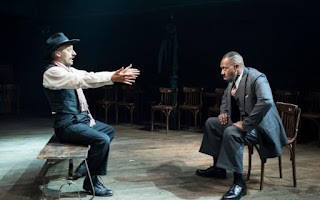
Tom Edden's actor schools Ui
Dictators: so bloody obvious, so crass… yet always underestimated in the rise. They are “resistible” and yet how often do they succeed?

This production reminded me of the Donmar verve of Cabaret (from 1994…) and the almost complete dissolve of the fourth wall by actors zipping around us, in the stalls and up in the gods, changing characters and singing snatches of songs new and old for the first bars of Human sung by Gloria Obianyo, to some Johnny Cash from Philip Cumbus: a cast of very fine voices accompanied by the multi-talented Ms Eaton on impeccable piano (she also sings, natch).

The play is of course all about groceries. Even in a Chicago of many distractions, a man’s gotta eat and who ever controls the supply of vegetables has his hand on the food-chain the underpins everything else.

Gloria Obianyo on song
Where there’s root vegetables there’s politics and the leaders of the trade association debate ways of neutering the influence of mayor Dogsborough (the excellent Michael Pennington) by appealing to his vanity in order to secure the loan they need for expansion in the docks.

Dogsborough is Weimar President Hindenburg who actually was gifted a country estate in exchange for favours in the East Aid Scandal. The programme notes include a list of overt references to the German political events of the thirties and it makes for painful reading.

Into this picture comes the gangster Ui (Henry) and his right hand man Ernesto Roma (Giles Terera) who keeps him, just about, on a straight course and out of any trouble he can’t handle. Ui’s squeeze is Dockdoris and he has a couple of psychotic lieutenants, the florist Guiseppe Givola (Guy Rhys) who’s not exactly smelling of roses and Emanuele Giri (Lucy Ellinson) who has the charming habit of wearing the hat of every man she kills.

Arturo out of control
The trade association tries to use Ui’s physical threat to control the situation but he and his troop are too smart for them at every turn, accepting every opportunity to move themselves onwards at whatever human cost: they are just more aggressive.

The resistance is led by attorney O’Casey (super turn from an adenoidal Justine Mitchell who’d I’d last seen in the Donmar’s superlative Kind Lear) but even the law is subverted through intimidation and thuggery and I’m afraid that an audience member was found guilty of burning down the Reichstag – sorry a warehouse… whilst another was killed in a clear implication of his guilt: you’d have hoped for better from a London audience but there you go… trust no one.

It was a performance of pure theatrical verve which the cast clearly enjoyed as much as the slightly startled audience. Props to director Simon Evans for the audacious staging and to his designer Peter McKintosh for one of the most pure-enjoyable and thought-provoking shows at this venue for some time.

Lucy Ellinson looks out on the audience
Lenny Henry showed that he has completed his transition to the stage and after so much Shakespeare is ready to tackle anything; you completely forget that he’s Lenny apart from one moment of near corpsing when the audience member was made up bruised and battered!

The rest of the cast were uniformly excellent with Lucy Ellinson almost Joker-esque in her joyful psychotics and Guy Rhys, the fearsome florist, particularly good alongside Lucy Eaton’s snarky Doris.

Before the second half began we were joined again by Doris/Lucy again who asked us if we thought she’d survive the play: “don’t shoot the piano player” if offered… but there are no guarantees in this brutal World in which one man’s word is only as good as his ability to back it up with force…


The Resistible Rise of Arturo Ui plays for another month – until 17th June. Tickets are available on the Donmar site but are very limited. Catch it if you can, a play for today and all those tomorrows we – collectively – let slide…

#Resist.

Ithankyou rating: *****

Tuesday, 3 January 2017

Truth Politics… Saint Joan, Donmar Warehouse

Joan of Arc was found guilty in 1431, pardoned 25 years later and canonised in 1920 – the only saint killed by the Catholic Church – prompting George Bernard Shaw to finally write a play he’d been toying with since before the war.

I only know Joan through Carl Dreyer’s silent masterpiece, The Passion of Joan of Arc (1928), which draws extensively on the remarkable primary source of the verbatim text of her trial although I have been to both Orleans – seen of her triumph - and Rouen where she was executed. They struck her down but she became more powerful than they could ever imagine (to coin a phrase).

RenĂ©e Jeanne Falconetti gave her all in the silent version, a theatre actor making her only film and here we have an actress known mainly for film but now maturing as a stage performer of tremendous power and sophistication. I’d previously seen Gemma Arteton in The Master Builder (Almeida) and The Duchess of Malfi (Sam Wannamaker, Globe) but here she gave a performance surpassing even the latter (reviewed on Catherine Joyce's A Play What I Watched blog) and one to savour from the close quarters of the stalls’ second row.


 Her Joan is full of teenage passion – Joan was only 18 when executed – and native wit working through her inspirational “voices” to establish her own cause and conscience: very much a creature of post-suffragette Britain and a transgressive vision of a woman freed of the need to dress and behave as a woman.

In the epilogue this new woman wonders if her time has finally come: “…shall I rise from the dead, and come back to you a living woman? …What! Must I burn again? Are none of you ready to receive me?”
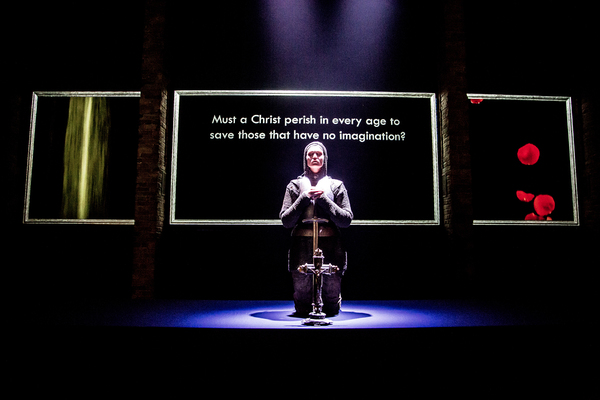
"Must a Christ perish in every age to save those that have no imagination?
This confrontational element is underlined by Director Josie Rourke setting events in a modern world of perpetual motion governing stocks, shares and news. GBS would have been disappointed to see capitalism still reigning supreme but hey, George, have patience a change is going to come…

It would undoubtedly come that much sooner if we had more like Joan who sits through cabinet meetings and court arguments with the same simple agenda – a popularism based on the call of God and Nature to stride forwards through the constraints of self-interest to a firmer future based on belief and not convenience.

She strides through a team of men who can respect but not truly understand her and if she was a sexual anomaly in 1431 and 1923 she remains one now blasting through ceilings of stone, concrete and now glass to present a visionary leader society has to restrain through the combined complexities of religious procedure and political expedience.


The men are like a malevolent Greek chorus mixed with a Pall Mall club who throughout underestimate this young woman, from their first encounter when she tells the French she must lead to fight to recapture Orleans and then crown the fey Dauphin (a marvellous turn from Fisayo Akinade), to her plan to re-take Paris. The new King decides he can’t finance her, the Archbishop (Niall Buggy) cannot support her theological drive and even her ally, Dunois (Hadley Fraser) cannot see how the expedition can work… she will be captured and he will not be in a position to use his forces to save her…

So, betrayed by such frail male hearts, Joan heads to her final battle in court… What is so impressive about Arteton’s performance is the way she paces her expression and the second half of this play is a masterclass in controlled explosions as Joan is swept up by hope and dashed by circumstance.


We believe in Joan’s rapture and her free-flowing tears and we share her impotent recognition as the fatal pieces fall into place: Arteton has emotional intelligence to burn and in the Donmar’s intimacy the sense of an audience holding their breath is palpable.

Some reviews have noted a drop in intensity when Gemma/Joan is not on stage and whilst some moments attempting to fit the text into modern corporate scenarios –  back-projected financial TV reporting on egg production and the battle-winning wind for Orleans – don’t entirely work, overall I really enjoyed the boys in support.

And, as Ms Rourke has realised, GBS’ Joan is still very much a story for all times: we must learn to differentiate those who act selflessly and not look visionary gift horses in the mouth. Now more than last January we face the task of democratically sorting the wheat from the chancers.


There is excellent support from Matt Bardock as in the dual roles of a cockney-spiv Baudricourt and northern hang-wringer D’Estivet, Richard Cant as the narrow-minded Poulengey and finally enlightened De Stogumber and Jo Stone-Fewings as the unacceptable face of proto-English colonialism, Warwick.

A tip of the many hats also to Hadley Fraser, Simon Holland Roberts, Arthur Hughes, Rory Keenan, Syrus Lowe and Guy Rhys. Elliot Levey is also good as the conflicted Cauchon who is ultimately devastated by the religious processes he hopes can bring salvation.

Joan runs until 18th February and – if you can find any tickets – beg, steal or borrow to see this!

Ithankyou Theatre Rating: **** and for Ms Arteton *****