Showing posts with label Park Theatre. Show all posts

Sunday, 26 April 2026

All about Alec... Two Halves of Guinness, Park Theatre


You can't win, Darth. If you strike me down, I shall become more powerful than you can possibly imagine.

Two halves of Guinness turned out to be two pints far fuller than empty and featuring a life overflowing with stories and character. Alec Guinness was the epitome of post-war British performers with iconic roles for Ealing and for David Lean, all topped off by his Obi-Wan Kenobi role for which the unconvinced Shakespearean was paid $150,000 plus 2.25% of profits and in which he featured in three sequels, and even in the latest episodes with The Force Awakens in 2015.

Fair to say, whilst he appreciated the money, Sir Alec was not that enamoured with “the fairy tale” science fantasy and at the start of this play we see an interaction with a fan during which the actor agrees to misquote a line from the film – “may the Force be with you…” on that condition that the young enthusiast never watched the film again.

The remarkable Zeb Soanes not only inhabits the character of his subject but also the man’s attempt to work out the value of his career and the issues that drove him. Soanes sounds enough like Guinness to quickly gain the audience’s confidence and as he asks for contributions offering other roles he has been in, he recognises and contextualises them all off script although I don’t think he quite caught my suggestion of the Llandudno-based comedy, The Card. Kind Hearts and Coronets, Bridge Over the River Kwai, Tinker Tailor… there’s no end of worthwhile work and all over so many decades.

The Entertaining Mr Soanes. (Photo by Danny Kaan) 

The play is written by written by Mark Burgess and is an extension of his original play from 2010 with new research adding to already meticulous details of career and character following Zeb’s request to perform the play again. All of the diligence allows the actor plenty of room to repeat key anecdotes with relish and, remarkably, to provide all the voices too from Sir Ralph Richardson to Sir Laurence Olivier and all points in between. Soanes also portrays Guinness’s mother – who turned up at the stage door on far too many pay days looking for a drink – as well as addressing the unknown ghost of his father who, unlike Hamlet’s, never answers back. The actor never knew who his father was – the entry was blank on his birth certificate – although he suspected it may have been his “Uncle”, Scottish banker, Andrew Geddes who paid for his boarding-school education at Pembroke Lodge.

Unsure of who he actually was and with such uncertainty in his relationship to the fixed point of his mother, Guinness resolved to be everybody who he could through acting – there may have been a deep-seated need to find himself in his roles although as with Peter Sellars, losing himself may have been just a much the aim.

Family uncertainty fed into fiscal frailty as the almost penniless actor tried to get a scholarship at RADA only for it to fall through – they were perhaps expecting some of the other Guinness family fortune? But on the same day he obtained a scholarship at another acting school, Fay Compton Studio of Dramatic Art, and his career began. He had boldly asked Sir John Gielgud's to offer him acting training and the two met with the older man offering him brief advice and recommending the skills of Martita Hunt at £1 a session… it was she who told him to always stress the noun before the verb giving rise to his distinctive vocal cadence.

Zeb Soanes. (Photo by Danny Kaan)

There after we’re taken on a tour of Guinness’ progress as his early-stage career is interrupted by his service in the Royal Navy during World War Two before he returned to the Old Vic and theatre. His first feature film was David Lean’s Great Expectations (1947) and he was to work with the great director on a number of occasions. Soanes is great in showing the then 33-year-old’s change of posture and accent to become Fagin proving Lean wrong in his assertion he could play that role and is such good value in retelling stories of the director.

One of these involves Lean bullying Sessue Hayakawa into giving a tearful performance as the Japanese camp commander Colonel Saito breaks down. This is as Guinness saw it but Hayakawa was an actor of such experience – a silent film great – I’m not sure how much encouragement he would have needed. But actors in the moments between being themselves may leave a trace of imagination in their recollections… this is Guinness on Guinness.

I shot an arrow in the air; she fell to earth in Berkeley Square.

Soanes quickly dies eight times in tribute to Guinness’ multiple parts in Kind Hearts and Coronets (1948), it’s a parlour trick but there’s no doubting that the actor could and did make those roles quite distinct. This ability to reimagine yourself from some kind of null space may have been linked to the actor’s own uncertain identity: Hitchcock may have turned his audience into voyeurs but here we’re light-heartedly urged to join the psychiatric dots in the manner of one of Sir Alec’s own… not least in relation to his family life and his sexuality with his list of London steam bathhouses for post-performance relaxation being a lengthy one.

Onwards across The Bridge, through the desert and finally up into space and that galaxy, far, far away until, at the last, a remarkable thing happens as piece by piece, Zeb appears to transform into Guinness as George Smiley… it’s a stunning impersonation; for once the noun accentuated just after the verb. Had we been hypnotised?

One actor in search of eight characters...

IThankYouTheatre verdict: ***** This play just flies by in a thoroughly engrossing blur of knowing flicks and revelatory twists as Zeb Soanes pays tribute to the man who inspired him to become an actor* and whose memory he has taken such care to preserve. Two Halves of Guinness is poured out with as much love and attention as the malted barley beer in the finest bars of O’Connell Street. You are in safe hands and will emerge feeling refreshed and enriched: Guinness is good for you whatever the measure.

Ably directed by noted actor Selina Cadell who has an increasingly impressive list of directorial credits including Twelfth Night and Uncle Vanya for the Donmar, Great Expectations at the Garrick and Hamlet starring Eddie Izzard.

As for Zeb Soanes he shows performance dexterity of the highest order and whilst he might be better known as a radio presenter he is a man of many parts – not just the 34 in this play! – and has always maintained his acting career. He played Derek Nimmo in the radio drama All Mouth and Trousers, by this play's author Mark Burgess… which reminds me of my father’s plans for a play with his old school friend Derek – Quarry Bank Grammar School knocked the scouse out of their accents but Nimmo as with Guinness could be who he wanted to be.

Two Halves of Guinness plays at the Park Theatre until 2nd May, do not miss it! Details of tickets are available right here.


*In the programme, there’s a copy of a note from Guinness to young Zeb when he wrote to him in his teens. Very similar to Guinness contacting Gielgud – the virtuous cycle of courtesy and encouragement!

Thursday, 4 April 2024

I saw the light… The Light House, Park Theatre

The World is full of broken things. Broken clouds, breaking waves… broken hearts. 

Oh, my heart… I’ve just left the Park Theatre and there's so much warmth on the streets. It's a feeling of connection on so much common ground after Alys Williams’ stunningly engaging performance of her own play. These words are inadequate to explain the contact we have just established and it is not just her ideas and performance but her ability to touch her audience in addressing the truth of the situation she describes; first through analogy and then through a narrative familiar to so many who have experience of living with mental ill-health.

Throughout, Alys mixes humour - this is a very funny play - and avoids direct descriptions that might only diminish a subject over-flowing with categorical thoughts… depression, suicidal ideation, therapy, psychiatry, chemistry… we’ve all got a take on this but we all have to take a breath and listen to new stories and new experiences as, like every lighthouse, the lights within those suffering are unique and amplified in different ways.

How many people do we know who have been depressed, tried to take their own lives, succeeded…? This is so painful we cannot look directly into the light. Instead, Alys takes us on her personal journey and, buyer beware, physically involves a number of the audience. As she says from the start, we get so stuck doing life by ourselves, “but maybe, just for an hour, we can do it together?”

And as one we proceed as two audience members are asked to echo “Man overboard!” as Alys explains the protocol employed at sea when someone falls into the waves. Another blows a whistle following Alys’ lead and she then throws an imaginary life belt over our heads, calls the captain and throws lights into the water whilst keeping her finger pointed as near as possible at the body bobbing in the waves.

Alys Williams, all photographs from Ant Robling

It's vital we remember this example as Alys slowly unfolds her own story about falling in love with a friend, Nathan, someone she met again when studying in Paris and then when she visited him in Dublin, the two venturing out to DĂșn Laoghaire to the West lighthouse in the harbour for ice cream.

Nathan is initially played by a table lamp but then by an audience member and I have to say that everyone of us called onto the stage is caught up in Alys’ world and we feel no fear, even when, called out as her father I have to pretend to row next to her, her sister and mother and sing Row Row Row Your Boat… this is some kind of witchcraft or Derren Brown levels of suggestibility, as I haven’t sung in front of an audience this big since the school choir.

But that’s what Alys is capable of – first play, first solo performances… one to keep an eye on for certain!

But it’s the way she deals with Nathan’s subsequent mental health issues that are the most beguiling. His light dimmed as the table light, she explains the difficulties in finding the right help in Ireland, his unpredictable swings and the time when he stood on a bridge during the night and almost left… What stopped him she asks, the fear of dying and his feelings for her but, as she says, he cannot live for her alone; there needs to be a firmer foundation. 

What there needs to be is a protocol, something we can all follow to give each other the strength to find and rescue the man overboard. By the end we are illuminated with the passion Alys has imbued in her words and the sense of the love that drove her onwards. It is a truly remarkable play that leaves you dizzy a little breathless and smiling your idiot happy smile all the train home.

Alys at sea. Photo Ant Robling

IThankYou Rating: Are you kidding, *****!

Andrea Heaton directs superbly and creates a blazing fire in the Park 90’s discrete space aided by Matthew Carnazza’s spot-on lighting design. Movement direction from Maya Carroll and Rod Dixon is also key to allowing Alys to command and let our imaginations fill the space whilst we get some Leonard Cohen, a sunny surprise Cliff Richard as well as a haunting but unknown to me, Our Song.

Nothing is overplayed and Alys’ restrain makes this pitch perfect play fulfil the publicity promise of being “a love letter to life”. It is also a reminder of just how potent theatre can be and how it can move us even on a rainy evening in Finsbury Park… for those are exactly the moments when we need to be part of a crowd, all striving to understand and play their part, literally in my case… 

Oh, please go and see this one while you can! 

The Light House plays at the Park Theatre until 13th April and details/tickets are available via their site here.­­­

Last word to Alys: “Our society is getting so much better at talking about mental health and suicide but I still don’t think we hear many stories about the care involved or the possibility of recovery. I think a lot of people have stories like ours, where someone has ‘gone to the brink’ as it were but found their way back into the light, perhaps over and over again through the years. I wanted to tell that story, to insist upon hope. In the end, that’s all hope is.”

Or, as the poet Pete Wylie said: “You’ve got to hope for the best and that’s the best you can hope for.” 

Together, we make that hope and as a group we sustain it.

Wednesday, 19 April 2023

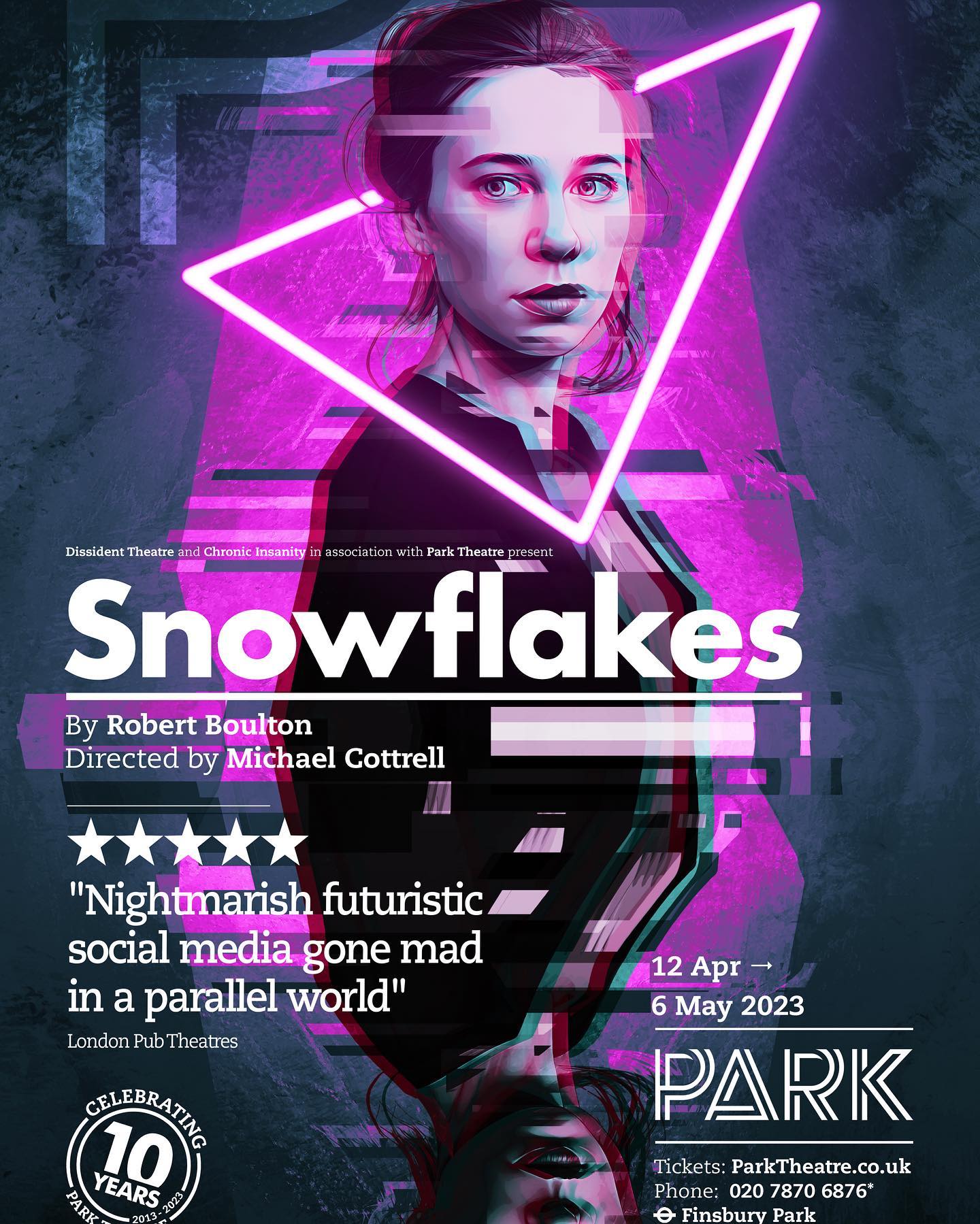
Killing us softly… Snowflakes, Park Theatre

Snowflakes is perhaps not the first play to use the idea of murder as an entertainment but it’s probably ahead of the game in following social media to its natural conclusion in this Age of Rage and our instant hot, takes of hate. Ever tried to establish a middle ground with someone you disagree with on Twitter, it’s almost impossible whether the subject is films, soccer or even something serious. Wrongdoers are a matter of opinion and not established facts because, Amber, Johnny not only has alternative facts but a social marketing budget of millions.

Snowflakes is funny, frightening and highly engaging, even more so than gazing at Twitter, Insta and Tik Tok for an hour and a half, which I’ve seen someone attempt in the front row of the Donmar until the performers intervened. There’s none of that in the packed house tonight because not only are the actors armed, they’re also killing us softly with their words like John Denver after a very bad experience at Centre Parks, of which more later…

Robert Boulton’s play has already been Offie-Nominated and you can understand why, it’s an audacious debut which dares to tackle its subject matter in a complex way with the debate largely mirrored by the trial by social media jury that is the centrepiece. For every attempt to trump the appeal of hyper-normalised misinformation there’s a response that points the finger at all of us leaving the question of how this will all stop especially for the generations now raised on the internet.

Boulton also takes the lead as Marcus, lead executioner of a start-up that specialises in capturing and interrogating individuals who may or may not have done something wrong but who having already been found guilty in the eyes of public opinion, now have to hope for the slim chance of talking their way out of being sentenced to death by an online audience with itchy trigger fingers. He got his big break after a notorious slaughter at Centre Parks which brought admiration and instant psychopathic stardom.

Louise Hoare and Robert Boulton (All photos from Jennifer Evans)

Along with rising star Sarah (Louise Hoare), Marcus captures writer and opinion maker Tony (Henry Davis) in a hotel room after he has just woken from a drunken night’s infidelity. Tony has been accused of sexual assault and whilst no charges have been brought and he continually denies it, he will have to mount a defence if he is to win over the already converted… who else would watch such a show.

It's Sarah’s first time and she’s inscrutably concerned about the details, much to Marcus’ disgust she hasn’t even decided what weapon she’ll use when push comes to slaughter. Louise Hoare presents Sarah almost as our witness to this extraordinary circus, she wants to make a difference but feels in neutral with a seeming objectivity which annoys Marcus. Boulton plays his man as almost likeable, he’s thoroughly persuaded of the importance and validity of his job and is far smarter than he lets on.

With Tony mostly unconscious for the first parts of the play the two characters feel each other out, Marcus ready to kill at any point and Sarah perhaps not fully reconciled to everything she’s going to have to do. They rouse Tony from his drugged stupor and the real debate begins as the camera is set up and his guilt or otherwise will be decided not so much by his honesty as his ability to appear convincing on screen.

Props to Henry Davis for his skill at feigning unconsciousness not just as we entered the theatre but also after being knocked out. His Tony is too clever for his own good and yet we are torn between his testimony and refusal to play the game and Marcus’ bloodied cynicism; he’s heard it all before and believes nothing.

Henry Davis and Louise Hoare (photos from Jennifer Evans)

But no one escapes the inquisition and all three will have to confront their own truth in a startlingly vivid final half. It’s a visceral treat in the close quarters intimacy of the Park with Mike Cottrell’s direction using every inch of the performance space as the characters move in relation to each other, the audience and our confused sympathies… there is no fourth wall left by the end.

There’s superb stage design from Alys Whitehead with a sparse set utilising Jonathan Chan’s lighting to shift focus and dynamics as the tension ebbs and flows. There’s also the most chilling of stage scraps, expertly directed by Bethan Clark, that had us shifting uncomfortably in our seats: this is not ambient box-ticking theatre, they mean it and it’s going to hurt.

IThankYou Theatre rating: **** We didn’t need a Twitter poll to decide on the play’s fate at the end as the ovation proved. This is not a play you’ll forget in a hurry especially as you turn on your mobile on the way home and it turns on you, the blue glow making you see red yet again. As Tony suggests it’s not about the politics anymore it’s about the personal and your very identity is under attack.

Snowflakes plays at the Park Theatre until 6th May 2023 full details are on their website, another fabulous show at one of the very finest independent theatres in London.


Saturday, 19 October 2019

The killing cure... Fast, Park Theatre

“What a doctor really wants is a cynical patient, someone who will question their pedigree…”

Theatre can transport you and it can educate and unsettle you and even in a Thursday afternoon matinee the story of ‘Dr’ Linda Hazzard and her kill or cure quackery was deeply disturbing thanks to four superb performances and the simple truth of it all.

This is a horror story and all the more so for it being based on actuality. Also, at a time when people can believe there’s no such thing as climate change or that Donald Trump is a proper president and that Brexit is the cure to all ills – starving ourselves of favourable business terms to set our country “free”… it’s instructive to watch an ignorant ideologue at work. Perhaps the disgraced Dr Andrew Wakefield is the best modern comparison for his incredibly damaging assertion that vaccinations cause autism; his work has been completely de-bunked and yet he’s still out there preaching and has single-handedly led to the re-emergence of measles.

Hazzard was an unqualified “doctor” noted for her extreme and unscientific fasting treatments at her "sanatorium", Wilderness Heights, in Olalla, Washington. Under her “care” some forty patients died and in 1912 she was finally convicted for the murder of a wealthy British woman, Claire Williamson, whose sister, Dora, narrowly escaped the same fate being just 60 pounds when she was rescued by a relative.
Jordon Stevens and Natasha Crowley (photo Manuel Harlan)
It’s an extraordinary story and Kate Barton’s play does it justice by focusing on the two sisters as well as the mindset of their “doctor”; what made Hazzard believe she was acting in anyone’s best interest? Did she simply want the cache of medical practice, was this Munchausen syndrome by proxy or was she just a psychopath and criminal – she was found to have forged Williamson's will and stolen most of her valuables; a common criminal.

Caroline Lawrie is superb as Hazzard, portraying her as a narcissist determined to prove everyone wrong and to inflict her ideas on the unsuspecting. She has the unbending passion of a cult leader and the force of personality to dominate victims seemingly for their own good or her gratification for, as the quote at the top reveals she relished a challenge and the chance to show her superior mind.

Into her orbit comes two wealthy English travellers, the Williamson sisters Dora (Natasha Cowley who I’d last seen in the excellent Anomaly at the Old Red Lion Theatre) and Claire (Jordon Stevens) who read Hazzard’s book of nonsense, Fasting for the Cure of Disease (1908). There’s good interaction between the two; bickering familiarities and sisterly sideswipes… they’re good fun, Dora the more worldly-wise and witty, with Claire the sweetly-earnest hypochondriac with her “tipped back uterus”.
Caroline Lawrie, Jordon Stevens and Natasha Crowley (photo Manuel Harlan)
They are soon under Hazzard’s spell though as she attacks their faith in medical Doctors: “how very typical of a man to recommend that kind of nonsense to a woman…” Her use of this proto-feminist line is not so much in support of the “free spirited”, corset free sister but just building herself up against the “fake news” of the established male, medical elite.

Soon she has the sisters drugged and separated, Dora subjected to repeated enemas and both starved of protean as they grow too weak to think, move and defend themselves. Luckily Hazzard has not gone unnoticed and a journalist, Horace Cayton Jnr (Daniel Norford) is on her case… but can he break through in time to save the women?

Spoilers ahead…

Dora lived to testify against Hazzard and the bad “Doctor” was jailed for her sisters and other deaths in 1912. She was released on parole in December 1915 and the following year Governor Ernest Lister incredibly gave her a full pardon. It is suggested in the play that her friendship with his wife had played a part and she was able to start again in New Zealand. Poetic justice finally caught up with Hazzard in 1938 when she died during a fast to cure herself… finally doomed by her idiotic ideas.
Daniel Norford (photo Manuel Harlan)
Kate Valentine’s direction brings out the full flavours of Barton’s script and she maximises the narrative tension as we go from quackery to murder. Cowley and Stevens are heart-wrenchingly convincing as the sisters incapacitated and slowly losing their minds as their life of forced out of them: it’s quite uncomfortable to watch their shift from vibrant youth and very impressive physical work from both.

Daniel Norford presents the heroic figure we need amongst this darkness and Caroline Lawrie not only makes us believe in her “Doctor” but also makes us doubt ourselves from time to time; surely the true mark of a sociopathic narcissist. Takes a real pro to go to the heart of darkness and still present a rounded human being who can, fleetingly, gain our sympathy…

Caroline Lawrie
IThankYou Rating **** Macabre and harrowing, Fast never lets its subjects down and is compelling theatre which leaves you wondering how many others have suffered in the name of people who just believe they know best.

Fast is a production of Digital Drama and has already enjoyed sell-out shows at the Brighton and Edinburgh Fringe as well as being shortlisted for Best New Play Award 2018 by New Writing South. One to catch!