Wednesday, 19 February 2020

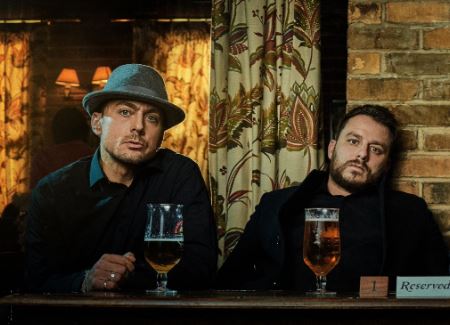
Stardust we are… Nearly Human, Perhaps Contraption, Vault Festival

We are like butterflies that flutter for a day and think it is forever…

Jimi Hendrix was so impressed having seen the band Chicago in 1969 that he said their horn section played like it was a single set of lungs. Well, from where I was sat tonight, Perhaps Contraption also have two collective lungs, along with a single-minded purpose - a powerfully syncopated mix of movement, words and something like a Vulcan musical mind-meld. This band is so tight and so joyously in tune with each other, their subject and their hugely appreciative audience that you cannot fail to move with them.

I’d seen the band before playing, amongst other things, the most outrageously arranged version of Radiohead’s National Anthem, all perfect be-bop phrasing mixed with a muscularity that one sensed owed at least something to the early jazz-prog of Robert Wyatt Soft Machine, Caravan and King Crimson – as confirmed by Artistic Director also flautist/vocalist/guitarist/tenor sax and contact juggler, Christo Squier after the show. But this is truly progressive music that has modern sensibilities and a desire to make something different.

It’s music as forward-thinking as Carl Sagan, an astrophysicist credited with helping to inspire this cosmic take on life, the universe and the sousaphone… No one else sounds quite like Perhaps Contraption and it’s hard to see many other bands taking on the subject of physics for a stage show that is also being turned into a concept album and, personally, I hope it’s a double and on vinyl too.

The performance starts, appropriately enough with Iain McDonald appearing like a Sousaphone Spaceman and explaining how we’re all so remarkably lucky and unlikely to be here. This is more than just a reference to the irregularity of Southern Rail services – the Vault festival is based in the cavernous underbelly of Waterloo Station, literally and underground festival… but the fact that our atoms, the enamel in our teeth, the nitrate in our digestive tract and the oxygen in our lungs has all come from the heart of stars long ago.


If ever there was a time to think about Man’s insignificance in the vast improbabilities of space, now is surely it. A repeated refrain from the band and the recorded narrators is that extinction is the norm and that survival is the exception and we simply shouldn’t take that for granted.

There are as many molecules in a single cell of DNA as there are stars in a typical galaxy...

Not that the band are giving us a PC lecture, they are simply celebrating our improbability and urging us to move onwards. Their songs have hooks to burn and they play with such movement and feeling with instruments rarely associated with dance. So it is that even glockenspiel and vibraphonist Amy Kelly plays on the move whilst bass trombonist Yusuf Narcin duels with Mickey McMillan and his trade-mark orange trombone. The King of Jazz, Paul Whiteman’s band may have swung but these guys dance and play as one courtesy of movement direction from Christa Harris and Lucy Ridley.

There so much light and dynamic shade in the group’s music helped by the range of instruments with Jin Theriault’s soprano sax a relatively recent introduction and also a variety of lead vocalists from Christo and Mickey’s masculine lines to tenor sax player Stephanie Legg and French horn player Letty Stott. The band sing close harmonies crowded forward on the playing are while the soloists hold back or mount the steps in the aisles; every inch of the theatrical space is used like a contrapuntal planetarium.

The sound is anchored by the combination of Iain’s bass voice and his sousaphone along with Riccardo Castellani’s drums; on some gigs the band feature mobile drums on a pram but here he has too much kit to wonder far.

The band provided a chart showing how the songs progress from the nature of our atomic particles – The person you love is 72.8% water… so drink them deep! – through a consideration of our place in this universe to the ultimate need to continue our particle journey far into space. A someone who grew up on scientist visionaries like Isaac Asimov and Arthur C. Clarke as well as Carl Sagan it is music of the spheres to my eager ears. Science fiction was never about escape it was about hope and now more than ever we need more of that.

IThankYouTheatre Rating: ***** This is vibrant, imaginative and playful performance with a hybrid of happy contemplative drama with lung-busting, body-impacting sound! I’m going back to see it again and I’m taking as many of my friends and family whose particles aren’t nailed to the ground.

We are, each of us, a little universe.

Nearly Human plays at the Vault Festival until this Sunday 23rd February – I urge you to get on quick and book tickets now. Details on the festival website!

You can also follow developments from the band on their website and here’s the link to that splendid version of National Anthem… try getting that out of your head!


More details of the band and their previous works on the PC website here.

Saturday, 15 February 2020

Pedigree chums... The Dog Walker, Jermyn Street Theatre

Pekingese are very good listeners which is more than can be said for most humans…

Paul Minx says his plays tend to stay with him, slowly marinating as the characters take over and begin to write themselves. The two in this play had their origins in the Nineties and, like lost dogs, have followed him through to their being wrote into existence for this quietly visceral and affecting play.

It was worth the wait as both dog walker Herbert Doakes and his client Keri, feel rounded and of such substance that they can hold contradictions as well as secrets even from the close-quarters audience in the Jermyn Street Theatre. Both take turns in being infuriating and almost utterly lost, propping themselves up with drink and drugs as well as the fantasy realities of work, irony and religion. As Keri says, “wounds heal but grief does not”, and Herbert, denying the failure of his marriage and Keri, blaming herself for a child’s death – caught in the cross-fire in front of her apartment – both try to lose themselves, to hide from their loss.

Minx’s dialogue is like vintage screwball pepped up with contemporary cussing and so well handled by both leads. Victoria Yeates makes for a febrile Keri, a role that could easily slip into ironic self-pity but she skilfully holds enough back to gain our sympathy and runs through so much emotional complexity when her relationship with Herbert begins to change in some alarming ways. The same can be said for Andrew Dennis as the more ostensibly comic Doakes, a man holding himself together through the disciplines of his dog walking job – Pups International – as well as self-help books such as The Seven Habits of Highly Successful Jamaicans. His story almost mirrors Keri’s as he goes from self-controlled/in denial to hard-floored reality over the course of the play’s three “movements” … music is ever present before and during the story and it is indeed a symphony of grief.

Andrew Dennis, all photographs courtesy of Robert Workman
“I am the most emotionally responsive dog walker in the district. I scored 4.8 on the City Empathy Test.”

At the start of the play we find Keri locked in self-pity as she drinks herself into a haze and dopes herself to meet the deadlines writing the e-books, such as Seven Habits… that people like Herbert read. She has a Pekingese dog, a bitch called Wolfgang Amadeus Mozart, and Herbert arrives to take it for the contractually required 28 minutes’ walk. But Keri is being evasive – drunk and disorderly – playing games with Herbert and greeting him on all fours barking like a dog.

Herbert recoils and recounts the numerous colleagues who simply refuse to take on one of the company’s more difficult customers. It soon emerges why Keri is so awkward as she explains about witnessing the child’s murder and being haunted by the Ghost Girl who she feels getting ever closer to avenging the transition from humanity to becoming a fatality

Herbert is a man of many facets, in addition to working as a janitor he also has a college degree and is able to receipt Spenser’s Faerie Queene and yet he lacks spontaneity and holds himself tightly within the bounds of Christian and professional duty. He bangs heads uncomprehendingly against the quicksilver wit of Keri who is so free spirited she is deeply lost, bewildering him with depths of atheistic nihilism. Finally, Herbert becomes concerned with the dog’s health and says he needs to file a UPR – Unwell Pet Report – before, finally, we find out why Wolfgang isn’t really ready for her walk, as she is now an ex- Pekingese.

Herbert becomes more of a tragi-comic figure in the middle section as he ostensibly returns to give Keri the “cremains” of Wolfgang only for her to throw the urn out of her window. He has bought some of his “mummy’s” jerk chicken – or jerk-off chicken as Keri has it, as a way of connecting but she’s not buying it. Herbert then talks of his relationship difficulties with his wife Julia and asks for Keri’s help in learning how to properly “pet” her… he crosses the line and the intensity darkens between the two as Keri repeatedly asks him to leave.

Victoria Yeates and Andrew Dennis. Photo Robert Workman
It’s only in the spectacular final third that we truly understand these characters and what exactly they are trying to hold together. That’s skilful work from the playwright but the actors have to perform it and they both achieve the significant transitions required and, as has been noted elsewhere, these are two characters you really come to care about. Harry Burton directs with precision and sympathy whilst Isabella Van Braeckel’s set design turns the Jermyn stage into a steamy Manhattan apartment drenched in the desperate hope that, against all the odds, redemption is still possible.

IThankYouTheatre Rating: **** The Dog Walker is as honest as the long summer days are long in New York City and that is why you laugh with and care so much about these brittle souls; we all like dogs but most of all we crave unconditional love. That’s one thing this smart production deserves too.

The Dog Walker plays at the JST until Saturday 7th March, tickets via their box office.

Monday, 10 February 2020

They fought the law... Time, Tristan Bates Theatre


If you can’t do the time, don’t do the crime…

Before the play starts we hear various South London voices talking about various capers including a poor fella who tried to crown a turf accountant with a cosh hidden in a newspaper only for it to fly out as the News of the World landed with a whimper and not a bang.

Michael Head’s new play is based on tales from the underground not unrelated to those his Grandad used to tell; stories from an age of criminal chivalry which still fascinates a time, as the older character Waldorf (David Schaal) relates, when there were rules and honour among thieves. Waldorf knew the Richardsons and a code of conduct that rationalised the violent side of their work as the only means of protecting the good people in their lives; family and friends, from men like themselves.

The Code meant that they would only ever battle their own and that innocents would never be harmed. The Krays, he reckons, we “unstable” and too interested in fame and a film star lifestyle whereas the Nashes, Frankie Fraser and the Richardsons followed the rules. It’s hard not to see this as a meditation on working class Britain or make that just Britain; what happened to our loyalties?

David Schaal and Michael Head
Four men meet up in a pub called The End of the World, jokingly referred to as the depths of South London Waldorf would go to get a drink bought for him. They’ve been on the run in various safe houses waiting for the heat to die down after a botched robbery and have met in this boozer owned by Slipps (Michael Head) who is so called because he has, so far, avoided doing any time.

He’s first there of course before being joined by Waldorf, a tall charismatic gangster who is their connection to the golden era of the sixties. The walls of the pub are lined with family photographs and the two reminisce about Slipps’ Uncle Mick as well as his Auntie who Waldorf romanced after Mick passed away. There are also notices of various family misdemeanours including Slipps’ Mother’s banning from Morrisons for illicit stock-taking. Some of these tales are true and from Head’s own family lore and that adds to the telling; this feels like a celebration of the extended family values many of us shared from the sixties and seventies when people mostly lived where they grew up and everybody had at least one dodgy Uncle Les and at least a couple of Aunty Flo’s.

The wise-cracking Fisherman (Daniel O'Reilly) is next up, ten minutes late because he hates waiting for people… He’s a total “rise taker” and kicks into his mate Slipps from the off with some delicious banter that makes you want to pull up a chair and grab a glass of that whiskey yourself. He reserves his fiercest barbs for the superbly named Prozac (Paul Danan) who is last to arrive and first to get the blame for the job just gone South.

Paul Danan and Daniel O'Reilly
Prozac, so-called for his addiction to every drug going, lives on his nerves and was panicked into using the gun taken only for show, during the raid, firing off “like John Wayne on crack…” aka Grand Theft Arsehole (I am going to borrow that next time I hit the M25!). Prozac claims the coppers started firing first but no one else remembers anything other than his mistake.

Things calm down as the whiskey kicks in and Fisherman lays out some generous lines of white powder and we get more excellently crafted stories and group interplay. Michael Head writes great, natural dialogue and, as with his previous plays, Worth a Flutter and The Greater Game, the shared narratives are the strongest, pulling you in with a smile as you recognise the bond between these mates.

The men discuss how crime has changed and how imprisonment was not only an occupational hazard it also helped you establish new contacts and relationships for more escapades once outside. Thus, is it that drugs suppliers help Uncle Mick develop his pharmaceutical business in South London – although strictly without heroin, another part of The Code. Prozac became pally with a lad called Pretty Face, and when they were outside, “getting properly pissed like Liverpool town centre on dole day…” (in fairness, it doesn’t have to be pay day, it can be any day), he reintroduced him to old school pal Slipps.

And so, bonds are formed and the boys go about their business; doing their best to make sure their families have different choices. Slipps has two daughters and doesn’t want them ending up with his lot; he needs to leave them a legacy.

Cracks start to show between Prozac and the others and they become more aggressive and open – it’s not just the coke talking though and there are deeper truths about family and love to be revealed.

The Time Team...
IThankYouTheatre Rating: **** You won't find a more compelling or entertaining night out with the lads anywhere else in the West End! Great characters and smashing stories.
Time is a very passionate play and the gang of four inhabit the roles with fulsome conviction (well, they’ve been sent down enough times…). Director Joe Withers makes the very most of the Tristan Bates intimacy and the biggest laugh of the night cam after a deft ad lib from Mr O'Reilly after a line from Mr Danan that speaks volumes for the tightness of this cast!


Time is only playing this week and is already sold out on some days so get in quick, it’d be a crime if you missed it! Details on the TBT/Actors Centre website.

I used to work with Ronnie and Reggie’s niece, she used to say her Nan would get her to behave by threatening to get her uncles onto her. So, if you know what’s good for you, get yourself down to Time as soon as!


Saturday, 18 January 2020

Splendid isolation... Beckett Triple Bill, Jermyn Street Theatre

Ah, it was a grand evening to be called Joyce in the Jermyn Street Theatre as Trevor Nunn presented three short plays by Samuel Beckett, an Irishman who often wrote in French but always thought in Irish, with an Irish cast plus one Mancunian.

The staging of these three quite distinct but thematically linked plays was stark and brave making the most of the JST’s intimacy whilst still somehow leaving the players so isolated. In Krapp’s Last Tape, Krapp (James Hayes) is lit by a single overhead light as he huddles over his reel to reel; the darkness makes him feel less alone, he says, yet it serves to accentuate his isolation and a course he has chosen if not exactly welcomed.

In Eh Joe, the titular character (Niall Buggy) is filmed by a video camera which is simultaneously projecting the recording onto the wall behind. It’s very powerful as the actor’s wordless performance is magnified as he listens to imagined the voice of an old lover (a chilling vocal performance from Lisa Dwan who I’m sure left shards of broken glass on the floor of the recording booth…) slowly break him down into tears.

Niall Buggy (Joe). Photo Robert Workman
The press night was packed and the run is nearly sold out already and it’s not hard to see why; this was a masterclass of acting and directing in the kind of space the minimalist Beckett would have loved for his one and two-handed plays. All three plays deal with memory from the point of view of men nearing the end of their lives; there’s intense loneliness, palpable regret and bitterness but also humour; these situations are funny no matter how dark they seem.

In Krapp’s Last Tape, a 69-year old man listens back to recordings he made at 39 when he had seemingly found his motivation for writing whilst at the same time losing out in a relationship that could have gone on a lot longer. He tells himself he does not regret the passing of his youth in the tape and in the present day says the same thing even as he winces at his own vocalisation of creative hope. I loved the patient staging here and the long moments of silence as Krapp goes around his desk to unlock his drawers revealing a banana; pretty much the first sound he makes is to cry out after he slips on the discarded peel.

James Hayes (Krapp). Photo Robert Workman
Eh Joe is altogether bleaker as Joe slowly but surely breaks down as the powerful voice of his dead wife cuts through his defences, hacking away at his silent resistance and relishing his wasted years. Let’s hope we’re kinder to ourselves when the time comes but this was extraordinary powerful theatre and Mr Buggy was mesmerising.

In comparison, The Old Tune was light relief as two old pals meet by chance and share misaligned memories of their past. In fairness Mr Cream (David Threlfall) has trouble remembering his grandchildren let alone previous decades and his pal Gorman (Niall Buggy) is little better, their recall about as reliable as Gorman’s malfunctioning barrel organ. Time is passing them by just as relentlessly as the constant stream of modern motor cars that often interrupt their discourse. Just two old fellas wondering what became of the people they used to be.

A tip of the hat to Louie Whitemore's atmospheric set and costume design as well as Max Pappenheim’s sound which plays such a vital role in all three plays especially in capturing every crack and syllable of Lisa Dwan’s voice and foregrounding the relentless rumble of progress passing by Cream and Gorman.

David Threlfall (Mr Cream). Photo Robert Workman
IThankYou Theatre Rating: ***** Pure concentrate of Beckett that gives the audience the full flavour of his words and intent thanks to excellent staging and genuinely astonishing performances.

Friday, 17 January 2020

Jazzed Shakespeare… Hamlet: Rotten States, Hope Theatre, 6FootStories

The play’s the thing
Wherein I’ll catch the conscience of the king.

The 6FootStories company have a mission statement “to create bold, exciting pieces of theatre that bend the rules of reality. We like to throw ordinary people into extraordinary circumstances, and explore the big ideas along the way, like LIFE and DEATH and FAITH.” Well, we got all of that in the most unpredictable of evenings in N5 during which Brian Blessed – although he was never present – was revealed to be Hamlet’s father!

The trick with deconstructing and then exploding Shakespeare is that you need to be able to perform it too and this the magnificent trio of Amy Fleming, Will Bridges and Jake Hassam do with aplomb, grounding this runaway reality in the lines of the play. They can improvise around the words as easily as Charlie Parker or Kamasi Washington can take flight with a tune but as with the jazzmen they know the formalities perfectly well.

At one point, Jake Hassam (who along with fellow performer-writer Nigel Munson, set up the company) coaches Amy Fleming’s character in the performance of one famous soliloquy; she goes loud, she goes soft until she get’s it reasonably right. The trio are playing gypsies who have been given instructions by Prince Hamlet to perform a play that, by telling how Hamlet’s father was killed, will reveal the true killer, the King’s brother, by his reaction and possibly that of his wife, Hamlet’s mother and the dead King’s Queen. So far so Shakespeare but the 6Footers take this all in their stride and weave a completely new narrative between their entry and exit in the original play.

Jake Hassam, Amy Fleming and Will Bridges All photographs by Matthew Koltenborn
Whereas Tom Stoppard took minor characters, Rosencrantz and Guildenstern, and explained their battle against fate, here the players are allowed to offer a meditation on the nature of the play highlighting some of what A-level scholars have long termed the awkward bits; Ophelia’s drowning/suicide, Laertes gullibility and the earnest Prince’s inability to kill in cold blood.

All of this is achieved through a mixing desk controlling a glitched, electronic score and also containing a variety of props; Gertrude is played by a polystyrene bust and she wears it well. It’s all so well pitched and perfectly timed – wasn’t it The Bard himself who said that was the essence of all good humour? Or maybe it was Michael McIntyre or someone funny at any rate.

The end result has the audience laughing in between giving thought to what some of the arcane original text actually means which is the greatest tribute. This company have made Shakespeare accessible without lampooning him just “remixing” him.

IThankYou Theatre Rating: **** The fastest Hamlet you’ll see, fast enough to be in the West End, with perfectly controlled sprints from each performer in and around the original text. Quite extraordinary and very funny! I mean, the state of Denmark!

Hamlet: Rotten States plays at the Hope until 1st February – full details on their website.


Friday, 10 January 2020

Talkies or walkies… The Delights of Dogs/Lullabies for the Lost, Old Red Lion Theatre

“There is violence and cruelty and bigotry and plain old crushing boredom but there is also nature and animals and art and sport, beauty and Virgil van Dijk!”

Rosalind Blessed’s two plays are packed full of sharp emotional relief, violent turns and bitter love turned shallow but nothing prepared me for the out of context mention of Liverpool FC’s greatest defender in thirty years. Van Dijk does indeed exemplify the best of the beautiful game and may well be a favourite of the playwright’s mother Hildegard Neil who makes a recorded yet highly impressive appearance in the first of tonight’s plays.

Two plays over something close to three hours is a lot to take in and for Rosalind along with Duncan Wilkins, a huge emotional undertaking, especially during the two-handed second play, The Delights of Dogs and the Problems of People, which involved a sequence of monologues and audience interactions, culminating in some of the rawest emotional displays you’ll see in any London theatre this winter.

Rosalind combines fierce charm with delicate emotional control and is a joy to watch in those soliloquies as she looks to audience, including us in imagined exchanges and even accusations; I was pointed at and called a pervert at one point and that’s the first time this year! Duncan Wilkins also has this playful confidence and plays off one audience member, “Steve” as his character – Ash - attempts to convince his soon to be ex-wife, Robin (Rosalind) that he has “mates” ready to help him recover from the dual blows of separation and pet-death.

“He might love me sure, but he certainly hates me…”

Rosalind Blessed and Duncan Wilkins, Delights of Dogs, photo courtesy of Natalie Wells
Dogs are a running theme across both plays – I hesitate to say “walking” – and exemplify the unconditional, pure and simple love that is seemingly beyond the most sentient of species. These characters are struggling to love themselves let alone their partners and relationships turn rancid in complex ways that we barely understand and yet which are clear enough if we would only look. The couple’s dog in Lullabies vomits in the back of their car and by the time they stop his bile has drenched their clothes much in the same way their relationship ends up soaking through their flat and their lives.

Food is also a common theme and in Lullabies Ash, prepares a meal for Robin as a peace offering whilst he recalls killing a fledgling crow by over-feeding it. The similarities between his lover and the stray animals Ash has always been attracted to are clear even to him but he can’t seem to think his way past it as she can. “No man is ever interested in what is on the inside…” exclaims Robin at one point before twinkling the briefest of apologies to half the audience before doubling down on what is an almost undeniable fact. Lads: we have work to do.

The direction of Zoe Ford Burnett – who is associate director of the Lehman Trilogy – is emphatic and clear, using the confined playing area almost as punctuation between the action.

Boxed in? Photo courtesy of Adam Trigg
The narrative is spread across a further six actors in the first play, Lullabies for the Lost, which sees a group in long-term therapy for eating disorders. Each gets to relate their story in a group session that will see them either come to terms and leave or extend their stay in an institution which seems as much a representation of their inner turmoil as a cure. Or rather, and not knowing Rosalind’s background in this area, it seems they need to choose to be cured, it’s not something that can be imposed on them.

We start off with the very engaging and all too relatable character of Larry (Chris Porter) as he struggles with himself over whether to go through with an invite he has accepted to meet with friends for dinner. If he leaves within five minutes he’ll be on time but he has a thousand worries – who will he sit next to, who he likes, who even likes him… he racked with doubt and worried his fragile recovery will be ruined by the evening.

Soon he finds himself in a room full of others and only gradually do we realise the connections between himself, the “Brothers Grim” – Jez (Nick Mulvey) and Tim (Liam Mulvey) – two men who just can’t connect beyond the surface, Sarah (Helen Bang), a neurotic who is too frightened even to tackle the mice in her flat and Nerys (Kate Tydman), a more confident woman who cannot let anything go after having her heart broken once too often.“I began to see the value in everything… I think things should have a value…” including, no doubt herself and the relationships that disappoint.

Kate Tydman (front) with (left to right) Duncan Wilkins, Rosalind Blessed, Chris Porter, courtesy of Adam Trigg
It’s like an emotional escape room in which the clues are obscured mostly by our own fears. Only scouser Andy (Chris Pybus) is able to come to terms with himself through the aid of a rescue dog called Millie who gave him a reason to get up and frame his active life around this most willing of partners. Before the Staffie came into his life, he was all but destroyed by his ex-, a “knock-off Kate Bush”; “the flesh is weak and the spirit envies the flesh’s strength…” and he wasted his life on corrosive social media, box sets and the illusory security of the bed.

Andy is able to leave but when anorexic James (Duncan Wilkins again) takes centre stage, the situation is put most eloquently as a trap of their own making: there comes a point when not everyone wants to escape. It is then that “Mother” appears projected onto the plain whiteness of the scenery, extoling the value of love and, indeed, Virgil Van Dyke.

Director Caroline Devlin moved the players around very effectively and the play is devastating, funny and so bravely personal from Rosalind.


IThankYou Theatre Rating: **** The year gets off to a flying start with complex and raw emotion delivered with so much humour and brutal charm. 

Rosalind Blessed and cast, Lullabies for the Lost, courtesy of Adam Trigg

Tuesday, 17 December 2019

You must see… The Invisible Man, Jack Studio Theatre

Alt-science fiction writer, Christopher Priest once wrote a novel called The Glamour which argued a perfectly logical basis for invisibility: that person that never gets served at the bar, the ones you bump into in the street… some people just have less noticeability than others and the logical conclusion is that some people you just would never be able to see. Priest is a huge fan of HG Wells and Derek Webb’s adaptation of The Invisible Man would no doubt find his favour as whilst, like Wells, he entertains and educates through counter-factuality as well as the glamourous force of his staging.

Webb is clearly in love with his source material and this is The Invisible Man as written by the ghost of Ray Cooney after a drunken dinner party at Vic and Bob’s in which they contacted the ghost of Will Hay and Moore Marriott. You want proof? Well, the theme from Oh Mr Porter was played at the beginning and end of the play! I rest my case.

This Invisible Man – let’s call him TIM – races by at breakneck speed and shows how three can become fifteen as our three intrepid performers take on many roles with uncanny poise and alacrity. Director Kate Bannister takes so many risks but it all works seamlessly and hilariously – hand on heart, I don’t think I’ve laughed this much in a theatre all year.

Mr Parker being positively protean! All photos Davor@The Ocular Creative
Now, a large part of that is the sight of Matthew Parker as brassy barmaid, Mrs Hall, a lady of rural Sussex origins who never gives a sucker an even break and is of a very particular purpose, repeating her mantra “rely on it…”. Matthew’s timing is impeccable as is his bumkin accent for Mrs Hall as she “supports” herself in a Les Dawson fashion and later captures the naked Invisible Man by the only part of his lower body she can hold on to.

Matthew gives a very moving performance in that he, literally, moves the scenery be it Mrs Halls bar of the Reverend Bunting moving his garden gate to follow the action as Dr Cuss (Scott Oswald) relates his extraordinary story. The shifts in setting are also signalled by the road signs at the side of the stage, a gentle pricking of the fourth wall which draws the audience in on the joke without disturbing the atmosphere of earnest mystery.

"You ain't seen me right?" Shaun Chambers
These three actors really put in a shift and, in addition to playing TIM, Shaun Chambers is also PC Jaffers, PC Fyffes and Police Chief Colonel Adye all of whom look remarkably alike to the untrained eye but who are, quite clearly, in completely different locations. But it is as the mysterious Experimental Investigator Griffith that we, erm, see him most. Griffith has attained invisibility through a series of experiments and is now in hiding trying to find his way back to the visible world. He starts off as a sympathetic scientist and ends up as an anarchist, intent on taking revenge on the establishment who failed to recognise his work and provide the proper support.

In much the same way as the Martians attacked Woking, gaining revenge for Wells who may have made an enemy or two when he lived there, the Invisible Man was his proxy for writing some of the wrongs in a country dedicated to researching weapons of mass destruction. Here though his targets are very contemporary ones – bankers, the political elite, all our favourite people.

Scott Oswald finds his Marriott
Scott Oswald, who may have been channelling Moore Marriott directly as Marvel, the man of the road, also plays Will Hay a porter and Fearenside, who works in Mrs Hall’s pub. Marvel starts to help Griffith as his money runs out and the scientist turns to the dark side, stealing to keep himself funded and robbing banks as his morality becomes less tangible than his corporeal form.

He ends up seeking out a fellow scientist, Dr Kemp (Mr Parker again) and attempts to force him into helping him… The play picks up pace as the character changes happen so fast, you’d swear there were at least four actors on stage at any one time in the breathless conclusion.

Kate Bannister fits a huge story into the play and manages the balance between music hall fun and trace elements of the original more serious intent. Webb also deserves much credit for bringing out comic flavours that don’t detract from the adventure.

The three actors work superbly as a team and tackle so much variety – what a challenge for Matthew Parker’s first acting gig after over a decade as a director? They all pass with flying colours.

IThankYouTheatre rating: **** The perfect Christmas fare from the Jack Brockley Theatre directed and played at speed by an energised trio-troop who fill out every part with comic conviction. The spirits of Hay and Marriott walked amongst us tonight but, as with the main character, we could only feel them, not see them.

Props to William Ingham’s lighting design, especially innovative for the denouement… Karl Swinyard’s design is also a wonder transporting us back over a century and at least 50 miles south geographically.

The Invisible Man plays at the Jack until 4th January – see it if you can, there may be returns if you’re very lucky!